
Every building needs a continuous air barrier, but exterior access is not always available. Renovations, historic façades, or zero-lot-line projects often prevent crews from sealing the envelope from the outside. Targeted Interior Air Seal (TIAS) brings that control back inside, creating a durable, low-VOC seal that bridges interior joints and penetrations without disrupting occupants or schedules.
How the Sealant Performs Its Job
This material is a water-based, elastomeric sealant engineered for interior applications where maintaining airtightness is critical. It cures to a flexible barrier that bonds to drywall, masonry, concrete, gypsum sheathing, and most coated substrates, closing cracks and gaps that remain after the primary air-barrier installation.
The polymer composition of TIAS provides elongation and recovery under normal building movement. The cured film remains stable when exposed to conditioned-space humidity and temperature swings, preventing micro-cracks that compromise performance. Because it’s fully water-borne, crews clean up with water, leaving no solvent smell hanging in the air.
Where and Why Interior Air-Sealing Matters
Air leakage doesn’t always occur at the exterior wall face. By applying the sealant from the conditioned side, teams can close those interior gaps before finishes are installed. Many assemblies include:
- Concealed cavities
- Soffits
- Shafts
- Window perimeters where exterior membranes are inaccessible
These discontinuities interrupt the air-barrier plane and can expose failures only revealed through code testing. Typical failures are often found in:
- Transition joints between demising and exterior walls
- Window and door perimeters on retrofit projects
- Penetrations around conduit and piping
- Ceiling-to-wall intersections below roof decks or parapets
Interior air-sealing in these areas helps maintain the building’s pressure boundary, supporting compliance with blower-door targets under ASHRAE 90.1 and IECC energy-efficiency standards.
Performance and Environmental Advantages
Every interior air-sealing product must balance mechanical performance with environmental safety, and this formulation addresses both sides of that requirement.
Low-VOC, Occupant-Safe Chemistry
Interior applications demand materials that perform effectively without introducing odors or volatile compounds into occupied spaces. The product bonds quickly, cures without releasing VOCs, and remains non-flammable. The water-based chemistry of Targeted Interior Air Seal achieves all three while containing no solvents or plasticizers, making it suitable for schools, hospitals, and active facilities where ventilation can’t be shut down.
Elastomeric Strength and Curing Behavior
Physical performance depends on flexibility and consistent adhesion under movement and temperature swings. Targeted Interior Air Seal delivers this stability through a durable elastomeric matrix that maintains adhesion as substrates expand or contract in the field. A continuous film about 25 mils thick provides measurable air-leakage reduction verified through ASTM E2178 testing. Cure times vary with humidity but typically allow finish applications within hours.
Because the compound emits negligible odor, work can continue alongside other trades without isolation barriers or respirators, keeping schedules tight and downtime low.
Compatibility and System Integration
Maintaining air-barrier continuity across a building envelope depends on materials that connect interior detailing to established exterior systems.
Targeted Interior Air Seal is part of PROSOCO’s R-Guard family of air- and water-barrier materials, designed to integrate with exterior components for full-enclosure continuity. Field use of the material demonstrates how it creates negative-side air control on retrofit and renovation projects where exterior access is limited. When projects require full-enclosure continuity, designers can combine interior and exterior applications within one specification.
The sealant adheres to surfaces treated with:
- R-Guard Cat 5 (cured)
- VB
- Spray Wrap MVP
This allows crews to tie the interior plane back into existing barriers without additional primers or specialty adhesives on cured R-Guard surfaces. This compatibility keeps the air-barrier system continuous across different wall assemblies and substrates.
Adhesion Testing and Compatibility Verification
Performance reliability depends on proven adhesion and film-continuity data across a range of substrates. Field testing on concrete, gypsum, and CMU surfaces confirms proper substrate preparation and compatibility under typical interior-application conditions.
Application Methods and Tooling
Installation follows the procedures used in PROSOCO’s R-Guard system guidelines, adapted for interior air-barrier conditions.
- Select appropriate tools.
Use bulk or sausage caulk guns for joints and penetrations, 3-inch brushes or mini-rollers for seams, and flat trowels or spray equipment for larger transitions. - Prepare the substrate.
Surfaces must be clean, sound, and free of standing water, frost, or loose debris to achieve full adhesion. - Apply the material.
Spread a continuous, even layer over gaps up to ½ inch wide. For wider joints, embed reinforcing mesh between two coats to maintain movement capability. - Allow curing.
At 70°F (21°C) and 50% relative humidity, Targeted Interior Air Seal dries to the touch in 2–4 hours, though drying time varies with temperature, humidity, and surface conditions. Do not apply subsequent coatings until it is dry to the touch. - Clean up.
Use a bucket of water and a rag for quick changeovers between tools. Because no flammable solvents are present, crews don’t need explosion-proof equipment or special storage, a practical advantage on any retrofit site.
Energy and Code Alignment
Interior air-sealing directly affects building energy consumption. Even small discontinuities in the air-barrier plane can account for more than 30 percent of total heat loss in cold climates. When those leaks occur at partition intersections or penetrations, exterior membranes alone cannot correct them.
Applying the compound from the conditioned envelope:
- Reduces air infiltration
- Lowers HVAC load
- Stabilizes indoor temperatures
- Improves occupant comfort
These outcomes align with ASHRAE 90.1 § 5.4.3 requirements for continuous air barriers and help projects meet IECC C402.5 compliance thresholds.
By restoring continuity without removing finishes or scaffolding façades, the approach also supports retrofit energy-conservation goals under local building-performance standards.
Field-Proven Safety and Durability
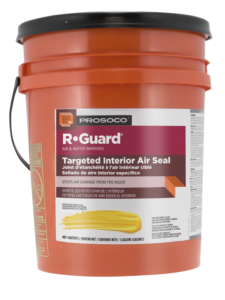
PROSOCO formulated this product for construction environments where worker safety and material longevity are equal priorities. Low-VOC chemistry keeps interior air quality within OSHA 1910 exposure limits, while the cured film maintains adhesion and flexibility through years of movement cycles.
- Tests under accelerated aging confirm resistance to cracking, chalking, and loss of adhesion on gypsum, concrete, and CMU substrates.
- Because the cured film remains vapor-permeable, it allows incidental moisture within wall assemblies to dry toward the interior, preventing condensation buildup behind finishes.
These characteristics position the sealant as both a performance upgrade and a maintenance-safe repair material for existing envelopes.
Explore PROSOCO’s Interior Air-Barrier Innovation
PROSOCO develops field-tested materials that maintain envelope continuity under real-world conditions. Targeted Interior Air Seal extends that reliability indoors with water-based chemistry safe for occupied environments. Contact us today for more information.