
Paint removal on concrete is never a simple cleanup. Paint coatings can penetrate porous slabs, age and wear unevenly, and leave residue that compromises appearance and adhesion if removal is mishandled. Understanding how to remove paint from concrete requires evaluating slab condition, coating chemistry, and removal method together, because concrete absorbs paint below the surface where aggressive shortcuts create permanent damage.
Why Paint Removal from Concrete Is a Surface-Prep Problem
Concrete behaves differently than metal, wood, or finished flooring. Liquid components migrate into microscopic capillaries and harden below the visible plane of the slab, creating mechanical and chemical bonds that resist simple scraping or rinsing.
Visible paint removal does not equal complete removal. Pigment and binder can remain embedded beneath the surface, leading to shadowing, discoloration, or adhesion problems later. Aggressive abrasion may expose fresh concrete, but it also alters surface profile and leaves permanent visual inconsistencies. That trade-off controls long-term surface performance.
When Paint Must Be Fully Removed and When It Should Not Be
Not every painted concrete surface benefits from full stripping. Knowing when removal is required, and when it introduces unnecessary risk, is a key contractor decision point.
Conditions That Require Complete Paint Removal
Full removal is necessary when coatings are failing structurally. Issues like peeling, blistering, and flaking typically indicate loss of adhesion below the surface, not just surface wear. Leaving residue behind in these conditions commonly leads to premature failure, especially if the slab is being recoated.
Paint removal is also required when discoloration, staining, or overspray affects exposed or public-facing concrete. Graffiti and spray paint fall into this category, since thin, high-pigment coatings penetrate quickly and spread beyond visible edges.
When Cleaning or Recoating May Be Sufficient
If an existing coating is sound, well-bonded, and compatible with a new finish, stripping may not be necessary. Some slabs can be cleaned, prepared, and recoated successfully without removing all existing paint.
This determination depends on coating condition, compatibility, and surface performance requirements. That decision sets the risk envelope.
Surface and Coating Assessment That Determines Removal Success
Every successful paint removal project begins with assessment. Skipping this step leads to inconsistent results and avoidable rework.
Identifying the Paint or Coating Type
Latex and acrylic paints typically soften under controlled chemical action. Oil-based coatings resist water-based cleaners and often require longer dwell times. Epoxies and high-performance coatings may require staged removal rather than a single application.
Spray paint behaves differently. Thin application and high pigment load allow color to migrate laterally and vertically within the slab, complicating how to remove paint from concrete without ghosting.
Evaluating Concrete Condition and Use
Concrete conditions govern how removal products perform. Bare, unsealed slabs absorb removers differently than sealed or polished surfaces. Smooth, steel-troweled floors release coatings differently than broom-finished or textured concrete.
Use matters as well. Interior floors demand appearance uniformity and slip resistance. Exterior slabs introduce runoff control, weather exposure, and adjacent material protection.
Paint Removal Methods That Work on Concrete and Why Others Fail
There is no universal solution for concrete paint removal. Method selection must follow, not override, surface and coating behavior, because how to remove paint from concrete successfully depends on releasing absorbed coatings without damaging the slab itself.
Chemical Paint Removal on Concrete
Chemical paint removers soften coatings at the concrete surface and within near-surface pores instead of relying on abrasion. Proper application thickness and sufficient dwell time allow the remover to break the bond between paint and substrate so coatings can be lifted without damaging the slab.
Professional formulations provide better control over dwell time, penetration, and release. That control reduces the risk of etching, ghosting, and profile damage that commonly occur with improvised methods.
Dwell time is a control variable. Thicker or multi-layer coatings often require extended contact to fully release. Manufacturer guidance and site conditions such as temperature and airflow determine effective dwell duration.
Mechanical Methods as Support Tools
Scraping, grinding, and pressure-washing have a role, but rarely as first-line solutions when surface appearance must be preserved. Mechanical methods perform best after coatings have been chemically softened or loosened.
Used without appropriate preparation, aggressive mechanical action can spread pigment, expose inconsistent texture, or permanently alter surface appearance. Support, not substitution, is the best practice.
Field Parameters: Pressure-Washing and Heat (Use with Caution)
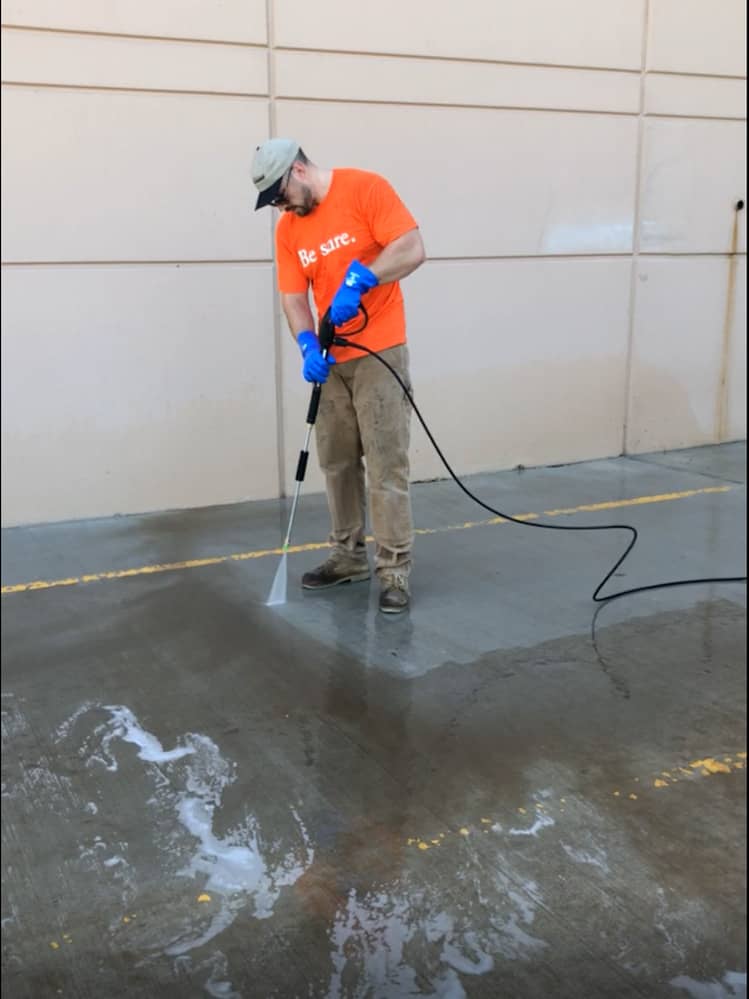
Pressure-washing can support removal, but control matters. Typical field setups rely on moderate pressures rather than maximum output, a wider spray angle, and sufficient standoff distance to avoid cutting the surface or driving pigment into irregularities. Match pressure to slab density and finish, and test before proceeding.
Heat may assist softening in limited scenarios, but uncontrolled heat risks surface damage, uneven release, or safety issues. Use heat only where compatible with the coating and substrate, and never as a replacement for proper chemical release.
Why Solvents, Acids, and Pressure-Washing Often Fail
Household solvents evaporate quickly and lack the dwell time needed to penetrate absorbed paint. Acids react with cement paste rather than paint, etching concrete without reliably removing coatings. Pressure-washing alone can spread pigment and moisture across the surface while leaving bonded residue behind.
These approaches often create visible damage while failing to fully release embedded paint, increasing the likelihood of staining or adhesion failure later.
Contractor-Controlled Step-by-Step Paint Removal Process
After assessment and method selection are complete, execution must follow a controlled sequence. This is where how to remove paint from concrete stops being theoretical and becomes a repeatable field process.
Step 1 – Site Preparation and Risk Control
Preparation determines whether removal stays confined to the target area or creates secondary damage. Adjacent materials, expansion joints, drains, and finished surfaces must be protected before application begins.
Ventilation, PPE, and access planning belong to preparation, not afterthoughts. Anything that interrupts dwell time reduces effectiveness.
Step 2 – Applying the Paint Remover Correctly
Paint removers must be applied evenly and at the thickness required to penetrate the coating and the concrete pores beneath it. Thin or inconsistent coverage leads to partial softening and reapplication.
Dwell time is not optional. Skipping it commonly requires reapplication and can increase the risk of surface damage during removal. The remover must remain wet long enough to break the bond between paint and substrate.
Step 3 – Lifting and Removing the Released Coating
Once the coating softens, it should be lifted using tools that remove material without gouging the concrete. The objective is extraction, not grinding.
Removed material must be collected carefully to prevent pigment from spreading across cleaned areas.
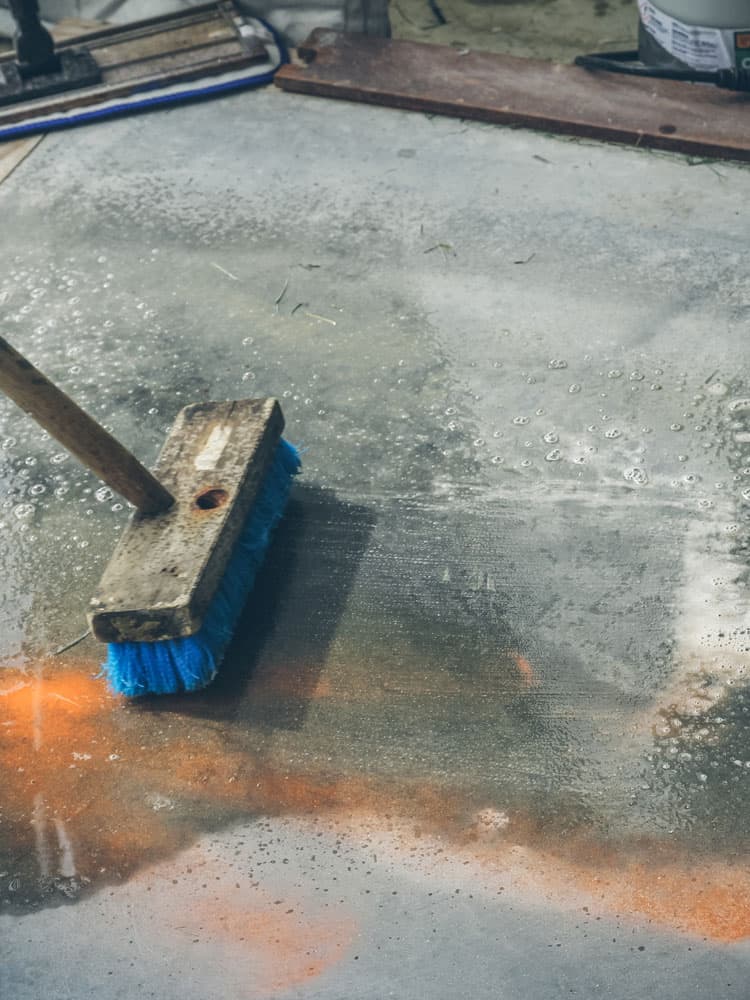
Step 4 – Rinsing, Neutralization, and Residue Control
Rinsing removes softened paint, spent chemistry, and residue that can interfere with future coatings or sealers. Incomplete rinsing leaves contaminants that may not appear until the surface is put back into service.
High-Risk Scenarios: Floors, Graffiti, and Public-Facing Concrete
Certain applications amplify the consequences of incomplete or aggressive removal, where small mistakes create visible damage.
Concrete Floors and Interior Slabs
Floors demand uniform appearance and predictable surface profile. Grinding often exposes inconsistent texture that becomes more visible after cleaning or sealing. Chemical removal followed by controlled agitation typically produces more consistent results.
Graffiti and Spray Paint on Concrete
Spray paint and graffiti introduce high pigment loads that penetrate quickly and spread laterally. Multi-layer or baked-on graffiti may require longer dwell times or staged removal to fully release color from the surface. Water-rinsable, compliant formulations help control residue and cleanup. Always test and stage removal to limit ghosting.
Exterior Slabs, Sidewalks, and Porches
Exterior concrete introduces weather exposure, runoff control, and visibility concerns. Sun and wind can shorten dwell time, while moisture conditions affect performance. Monitoring conditions improves consistency and reduces rework.
Final Surface Readiness and Recoat Risk Prevention
Paint removal is complete only when residue is gone and the surface behaves predictably, which is why removing paint from concrete should be treated as a surface-prep process rather than a cosmetic cleanup. Visual inspection alone is not enough; tactile checks help identify remaining film or slickness.
Define “clean” as a condition, not an appearance. That distinction protects downstream performance and reduces callback risk.
Select PROSOCO Paint Removal Solutions for Concrete Surfaces
PROSOCO develops paint removal and surface preparation solutions engineered specifically for porous masonry substrates. Selection should match coating type, layer build, and exposure conditions, favoring water-rinseable and compliance-focused formulations where appropriate. Proper selection reduces surface damage and improves predictability. Contact us today for more information.